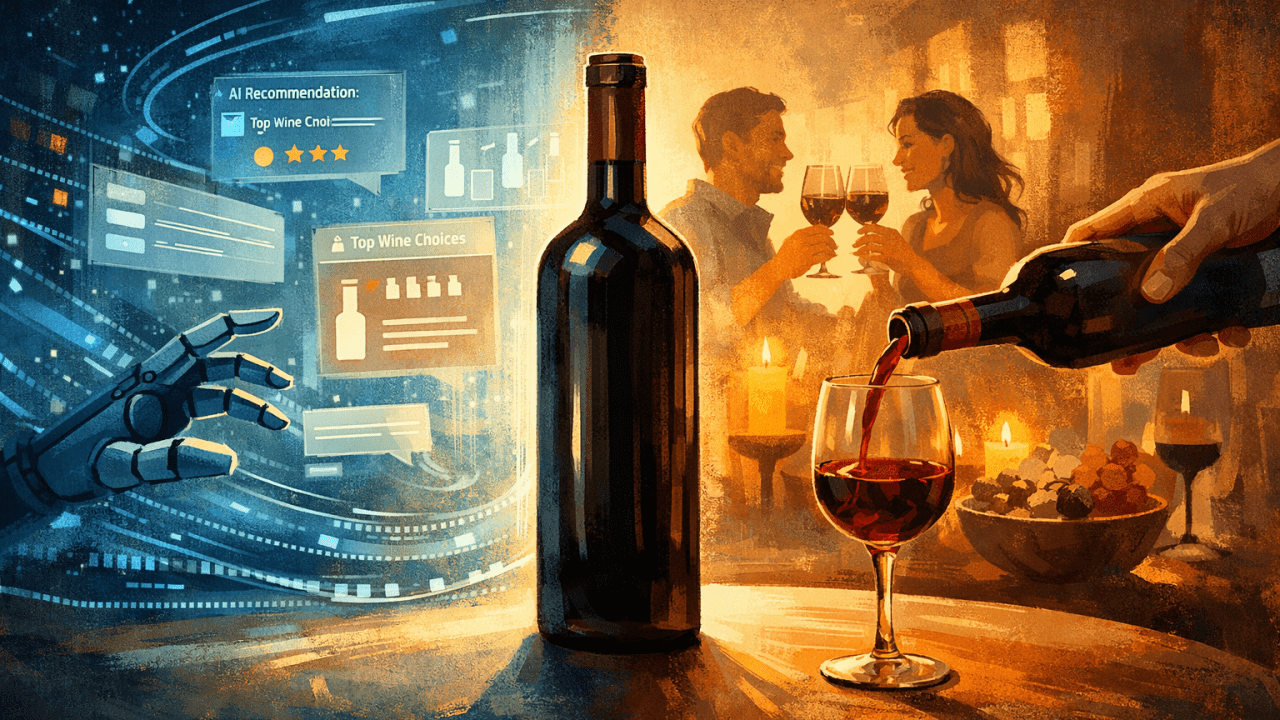
Image is AI generated.
When we write for computers, we miss the opportunity to connect emotionally with humans. And far too many wineries are headed towards a slippery slope of sameness.
Winery owners and managers should immediately focus all marketing efforts on driving traffic to their tasting rooms because the brand noise will be deafeningly loud by the end of calendar year 2026.
Artificial Intelligence (AI) is not completely to blame for wine marketing’s challenges – it’s only accelerating a trajectory that started over 25 years ago. But what chain of events conspired to create a situation so overwhelming to us that we needed AI to be the life raft that saved wine?
2000 – to improve search engine rankings we identified 50-100 keywords and phrases we wanted to be known for, incorporating those terms into landing pages.
2005 – to directly influence buyer behavior we created loyalty programs, spending millions of dollars mailings, member rewards and benefits, and personalized digital experiences.
2010 – to influence ambassadorship at retail we gamified “edutainment” to help train the floor while stoking them out with discounts, merch, and behind-the-scenes brand access.
2015 – to signal relevance we leaned into social media and email marketing, with content calendars that supported new releases, seasonal menus, events, and promotions.
2020 – to get “liquid to lips” we deployed massive, nationwide sampling efforts, using sponsorships and pop-up events to introduce brands to Millennial and Gen Z drinkers.
2025 – to appear in AI responses or overviews we focused on establishing brand authority, including generating reviews, public relations, and direct, answer-based content.
Today – to connect with drinkers we use our favorite AI Assistant to draft news releases, A/B messaging tests, long- and short-form copy, bottle label creative, and more.
Tomorrow – for drinkers to discover new brands, digital agents will help curate individual shopping lists and make wine recommendations when dining out.
So, we’re using AI…to talk to AI…to help drinkers decide whether to try our bottle of wine. The engagement is purely transactional. As a brand, we’ve done our best to signal credibility and authority for Answer Engine Optimization (AEO) purposes. And as a drinker you’ve instructed your AI Agents on your preferences, with memories of past dialogs and buying behavior to guide future wine recommendations. The best case scenario is the stars align and our winery is served up in the shortlist of responses to the current prompt.
From a drinker’s perspective, this may not be a bad thing. AI helps remove some of the friction that has existed in the wine industry for a while now. At retail, shelves are crowded, still sorted by geography, varietal, and price point. This setup is fine for those consumers who know what they’re looking for, but it’s not optimal for those shopping with an occasion in mind. And if wine hopes to grow with new audiences – especially younger LDA drinkers – helping buyers see themselves drinking our wines with friends is crucial. Prompting AI before shopping gives the buyer confidence and intent, and using AI at-shelf can help them evaluate an entire section of wines to return a selection quickly. This is especially useful when there are fewer staff members educated on the store’s offerings.
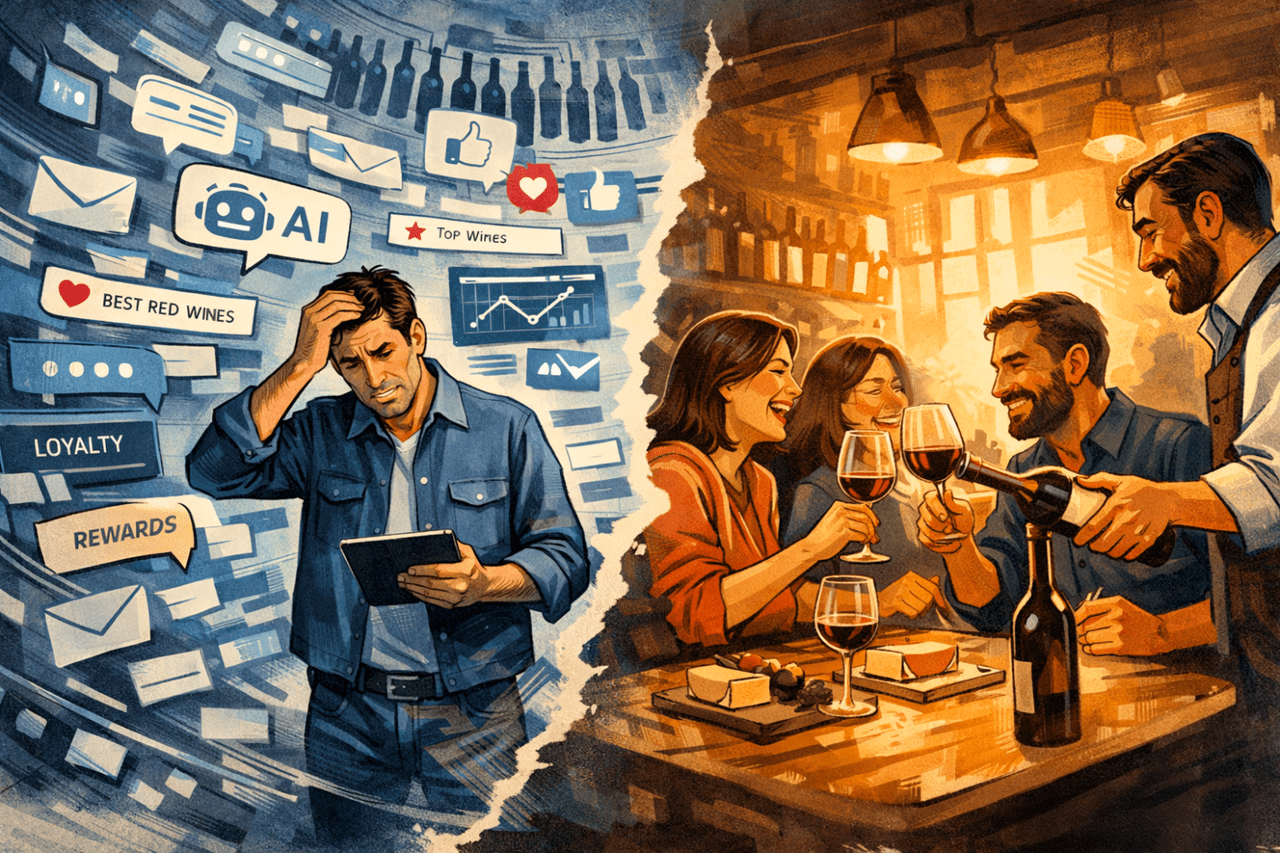
Image is AI generated.
On-premise is no different. For restaurants and bars with a basic wine selection, guests will order what they know, or the servers can help guide them. Larger menus still tend to group by geography, then varietal, requiring knowledge of wine-food pairing to navigate. Fine dining restaurants deploy Sommeliers to personalize guests’ wine experience, quickly establishing trust and rapport to help guide choice from a carefully curated selection using more qualitative filters (i.e., what is your mood, what are you celebrating). Some guests will never ask for help, or don’t want to engage with the Som for fear of being challenged or upsold. In these cases, AI assistance opens wine up to new audiences, leads to a wine sale, and may even help turn the restaurant tables faster. And on the business side, AI could help build wine lists for new restaurants that don’t have an expert on staff.
So, what threat does AI pose in either of these scenarios? The crowded wine shelf at retail is still there for perusing. Restaurants are still buying bottles from distributors and selling wines by the glass. And Sommeliers are still part of the fine dining experience for guests willing to engage. The difference? AI shifts the balance of power in favor of the drinker. In a similar way to Google’s indexing of the world’s knowledge. Or ecommerce making West Coast wine available to our friends in the East. Or social media providing the platform for individual voices to be heard. AI is prompting recalibration of many long-held beliefs around how wine and countless other products and services are marketed and purchased. As winery owners and managers, we must decide how to meet drinkers where they are, enabling engagement with our brands on their terms: whether that’s interacting with another human or self-discovery through third-party tools.
Let’s be clear: wine needs AI to grow, not to survive.
Wine needs humans to care; to buy their wine; to enjoy the tasting experience; and to tell their friends. Today wine needs AI to help connect with those drinkers, because the playing field is far too competitive to grow organically. If AI is the newest advertising channel, the tasting room must be the message. The tasting room is the one place where our brand, personality, origin story, and bright future are all on display alongside our wine selections. It’s where tours of the vineyards originate, weaving a unique tale of terroir and season. Nearby you’ll find equipment standing at the ready, boasting conquests of harvests past and future. It’s a short stroll to the cellars: a window into wine’s history and the artistry of its caretakers. And it’s the meeting point for friends and family to share unforgettable experiences.
It’s impossible to evoke those feelings at shelf. Most Sommeliers have never visited the properties of their restaurant’s wine selection. And many drinkers don’t yet realize our wines should hold a special place in their heart or cellar. Their first experience with our wine was likely transactional, after all. AI tools delivered a shortcut to help check something off their list: a quick means to a “yes” that didn’t require extra thought or energy. Most would consider that a win.
Winery owners and managers owe it to themselves to tell a better story.
Recently we visited Whitehall Lane Winery in St Helena, CA, at the front end of a friend’s 50th birthday weekend in Sonoma. We had hoped to catch Co-Owner Katie Leonardini but just missed her (Friday afternoon traffic on the Golden Gate Bridge, oof). This could have prompted a transactional experience with the winery: leave a note for Katie, pick up a couple bottles of wine, and head down to Sonoma. Instead, the Assistant Tasting Room Manager, Aubrey, invited us to take a tour of the entire property, including the crush pad, cellars, riddling room, vineyards, private event spaces, and guest house. Even the newly installed pickleball courts. All along the way telling the unique Whitehall Lane story with the passion, personality, and professionalism of someone who fully drinks the Kool-aid (he has nearly 5 years with the winery).
Not only was that the perfect way to start our wine country weekend, but it reawakened in me personally everything I remember about working directly with winemakers, distillers, and brewers in various capacities across my career. There has always been romance in wine. An art and a science. A love of craft that exists far below the business layer of distributor relationships, growth goals, and quarterly profit reports.
Everyone should be so lucky to work on a business that makes you feel that.
If we want to introduce our wines to new drinkers – or to continue to stoke the loyalty of existing fans – we need to find a way to package up that emotion and deliver it across long distances. This is where AI can be a gamechanger for brands: when it’s a megaphone for all the experiences our guests have with our wines. If a drinker in Ohio asks any AI for help selecting a red wine, it will prompt them for signals like occasion, mood, meal, guests, style, and budget. Not wine specs like vintage, appellation, and other production data. Not the origin story, brand positioning, or marketing messages. Not even the pedigree of the winemaker is more important in this moment than showcasing the guest experience.
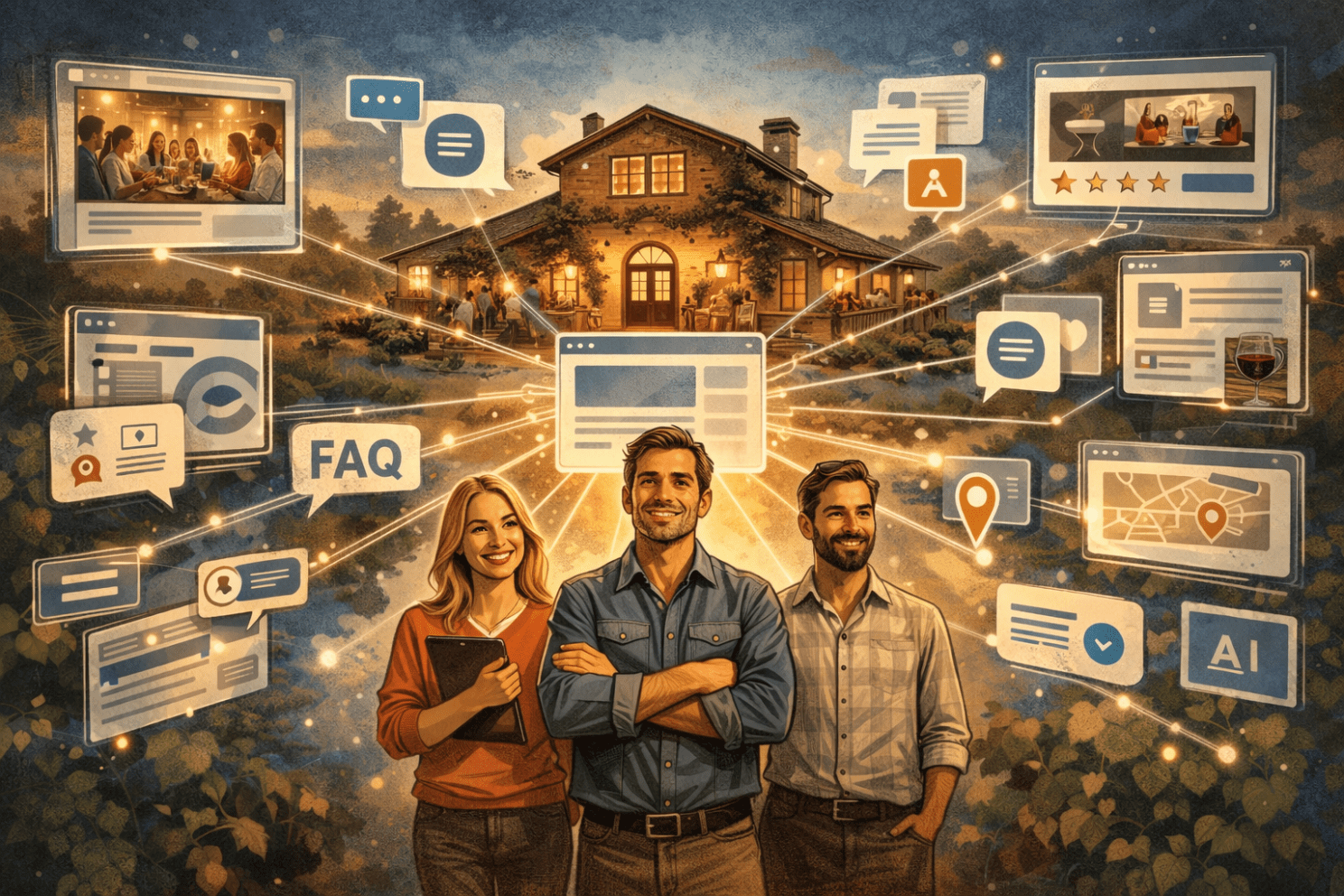
Image is AI generated.
Realizing this theory could upend the ways we’ve traditionally promoted our wines, we’ve identified 10 tactics in 10 days to help wineries show up in AI search:
- Describe your space: map your spaces to the descriptors consumers use to search. Build event landing pages organized around occasion including corporate, celebratory, date night, group tasting, and others. Use photos of guests enjoying the space to help tell the story visually (with permission, of course).
- Promote your events: Most wineries announce events but don’t describe them richly enough to be useful to an AI. Instead of “Join us for a spring wine dinner,” write copy that includes the wines being poured, the food pairings, the setting, the style of experience, and your ideal visitor. You’re documenting events in a way AI systems read them. Be sure to display the current events calendar on your website.
- Add an FAQs page: AI tools are trained to answer questions. They do their best work when they can find a source that answers a specific question directly. An FAQ page is a map of questions your guests are already asking, paired with your own authoritative answers. Notice the holdover from SEO days here?! If your site is connected to Google Analytics, find the top 5-10 landing pages and add a short list of FAQs at the bottom of those pages as well.
- Ask for reviews: Scores and reviews from Wine Spectator, Wine Advocate, Decanter, and Vivino carry real weight in AI training data and citation patterns. Build a process for encouraging buyers to rate your wines there for a compounding effect over time. Allow guests to provide feedback or ratings after events, both on your website as well as third-party calendar aggregators.
- Write a press release: Articles in trade and enthusiast publications feed directly into what AI systems reference. Pitching your story to wine-friendly journalists is especially useful for larger events (think 200+ attendees), festival sponsorships, or series events on a recurring schedule. Similarly, a short press release or recap pitched after a notable event with a quote, attendance note, or interesting angle builds the kind of third-party documentation that AI systems trust.
- Participate in wine message boards: Where possible/practical, play an active role on platforms AI systems index heavily, including Wine-Searcher, CellarTracker, and the above review sites. Presently, AI models rely heavily on Wikipedia and Reddit for authoritative content, so it’s recommended to participate in both (just be transparent about working for the winery).
- Encourage social media (with guardrails): Like it or not, AI models reference all the social media channels (including YouTube) to gauge current sentiment, personal experiences, and professional thought leadership. When a guest has an amazing tasting at your winery and shares it with friends, AI looks for signals to indicate a friendly staff, an inviting tasting room, a beautiful property, and of course quality wines. We also understand the role Influencers may play in the future of wine marketing and the choice wineries must make about allowing, restricting, or even banning them altogether. We recommend designating areas of the winery specifically for social media and proactively defining a content capture protocol that paid Influencers must follow. Or consider a wall poster for a more casual social contract with guests.
- Use email to promote events: A clearly defined email strategy has a more indirect impact on AI search. We believe email is an underutilized tool for driving traffic to tasting rooms or events. Using similarly rich content to describe your events and space in an email creates a sense of urgency and fear of missing out (FOMO) for recipients. The more guests you have on-site, the more opportunity you have for positive reviews, which increases credibility and authority for your winery in the AI models. Remember to use visuals that help guests see themselves enjoying a glass of wine with their friends in your tasting room.
- Retail locator: AI is increasingly acting as a decision layer between users and retailers (our “Tomorrow” scenario in the timeline above), with the AI directly influencing purchase. For wineries, having an updated retail locator will help inform AI responses to wine prompts, combining user location data, behavior/buying history, and on- or off-premise proximity to make local recommendations.
- Add the LLMs.txt file to your website: A proposed web standard called llms.txt works like robots.txt but for AI systems, giving AI models a clean, formatted snapshot of your website’s most important content and links. Use a generator to crawl your website from the homepage outward; extract and categorize key content and metadata; filter out noise and duplicates; and output a llms.txt file which you can then upload to your site’s root directory.
If our winery follows the above recommendations, we will start to gain meaningful traction in AI search. Content we create around spaces and events has a compounding effect that AI notices. But remember: the AI models and how they process and present data are constantly evolving, similar to SEO best practices for the past two decades. So, winery owners and managers will need to quickly adapt to changes to maintain relevance and priority in results. Currently our best bet is to think of events and guest reviews as opportunities for third-party content and validation of our winery’s authority in a qualitative, emotional way that the wines alone cannot. And if we consider AI as a tool and not a strategy, we’ll continue to write a genuine brand narrative to help drinkers connect with our wines for years to come.
Originally published 4/20/26 on Rethinking the Wine Industry
Priscilla Hennekam is a Brazilian-Australian strategist and communicator, recognized as one of the most authentic and forward-thinking voices in today’s wine industry. She is the founder of the global movement Rethinking the Wine Industry, where she explores the power of collective intelligence and a creation mindset to drive meaningful change.
MailChimp archive: https://mailchi.mp/386393cde39b/260420_aireadiness?e=bd76eedb35
Download: https://app.box.com/s/tsdrw5z88y3am2h97bguxyuqbpoav21w